The “Yellow Vests” (Gilets Jaunes)[1] surprised President Emmanuel Macron, who is seen as the “man of the financial oligarchy” in France.
Before I move to some relatively boring stuff, I want to share that I support the protests.
Because it is more than a protest that is simply against to the new taxing.
Because it also includes lots of other claims that should remind the French government its resposibilities towards French people.
Here are some of their claims:
– Promote small businesses
– Same pension system for everyone
– No retirement below 1200 Euros
– Protect French industry, protect jobs
– Implementation of a real integration policy for migrants
– Better education standarts for children
etc.
Looks like nothing more than what a person should expect from a social state.
P.S.: Personally, I didn’t support “let’s burn some Porsche on Champs-Elysées” part. I mean you shouldn’t destroy something that beautiful.
The fuel prices has increased throughout the year and the new tax plan announced by Macron’s government was the last straw for the protest. Thousands of people, who were not satisfied with the government’s economy policies, took to the streets. The protests took over the French agenda due to high participation and police’s brutal intervention. According to A. Kantola: “Journalism contains a view of the world, a social cosmology or a political imaginary by which our societies and life are imagined”. The affect of journalism on people’s believes is undeniable. But as we all know, especially when it comes to social events, the representation of news by journalists are not the same. There are lots of factors that effect journalists’ framing of news. Here I will just try to show two factors that may determine news framing.
One is the ideological differences, another is the type of media; mainstream or alternative. By now, we know that alternative media outlets (sure not all of them) tend to support social movements that seem “marginalised” in the eyes of elites.
Framing of ‘Yellow Vests’ in Mainstream Media
The Collins Dictionary defines mainstream media as “conventional newspapers, television and other news sources that most people know about and regard as reliable”. To understand how mainstream media frames the protests, first of all we need to know what framing means. R. Entman defines framing as following: “to frame is to select some aspects of a perceived reality and make them more salient in a communicating text”. It is possible to detect the frames by keywords, images or by checking the sources of information. The experiments made on news consumers show that frames affect how people understand a problem and how they act upon it.
Let’s check the ideology factor by checking the news titles about Yellow Vests in two major French newspapers: Le Figaro and L’Humanité. Le Figaro is known as right-wing and L’Humanité as left-wing.
In Le Figaro, the perspective of ‘elite discourses’ is in the forefront. The title used in Le Figaro to describe the seriousness of the events is: “”Yellow Vests”: beyond the rumours of chaos, the reality of a threat”. The protests have been introduced as “a threat”. The keywords used in most of the articles are; violence, rebellion, threat.
L’Humanité focuses more on the democratic aspect of the protests. The clear example of it is the following title: “Yellow vests. From virtual to real, democracy 2.0”.
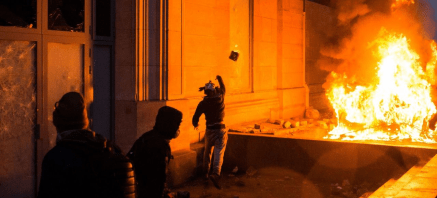
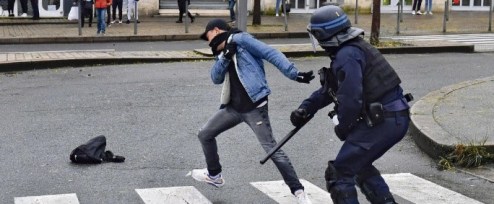
Besides the language of these two newspapers, there are also differences in the used images. Le Figaro uses more of images which show the protestors as the violent ones, whereas L’Humanité points out more of police brutality
Le Figaro
L’Humanité
Framing of ‘Yellow Vest’ in Alternative Media
Alternative media differs from mainstream media by its sources, funding, structure and audiences.
To see the difference in framing of ‘Yellow Vests’ between mainstream and alternative media, I will take news examples from two French alternative media: Mediapart and Agora Vox.
Mediapart is an independent news outlet that was born voluntarily. In the news about the protests, Mediapart uses social media, especially the protestors’ comments on Twitter, as source of news. As seen in mainstream newspapers, there is not a recurring keyword. Instead, we find the slogans used by protestors which transfer the claim of the protestors to audiences in a clear and simple way. It is also possible to find a few articles opposing Macron’s latest policies.
Agora Vox defines itself as a participative media outlet. It allows audiences to express themselves. Agora Vox’s stance is openly against Macron’s recent policies and it supports the protests. Agora Vox presents the protests as an act of democracy and it emphasises its necessity. The keywords that repeat are ‘democratic resurrection’, ‘renaissance of the democracy’. It accentuates that people from all walks of French society participate in these protests, which makes the protests legitimate in the eyes of the audiences.
I draw two main conclusions from reading these sources. The first is that when we compare the two mainstream newspapers, we see that the ideologies of the newspapers highly impact their way of framing the news. One draws a portrait where the protesters are represented as dangerous rebellions, while the other gives more weight to the government’s erroneous policies. The second conclusion is that the alternative media uses different sources and different framing methods than mainstream media. Sources can be anonymous eyewitnesses or social media. The news are produced by volunteers. But the most noticeable; it openly takes the protestors’ side. And it says the ‘unspoken’.
[1] In France, it is compulsory to have a yellow vest in every vehicle. It acts as a reflector in case of an accident. During these protests, in a sense, yellow vest is used as a symbol to give a message: “Attention, révolte!”.


 food and politics
Leave a comment